About the book
The World After AI
Why the Future Is Still Ours to Shape
The World After AI follows five people through one ordinary Tuesday in 2035, then lives that same day again, differently: same people, same technology, opposite choices. It is not a book about what AI will do to us. It is a book about what we will decide.
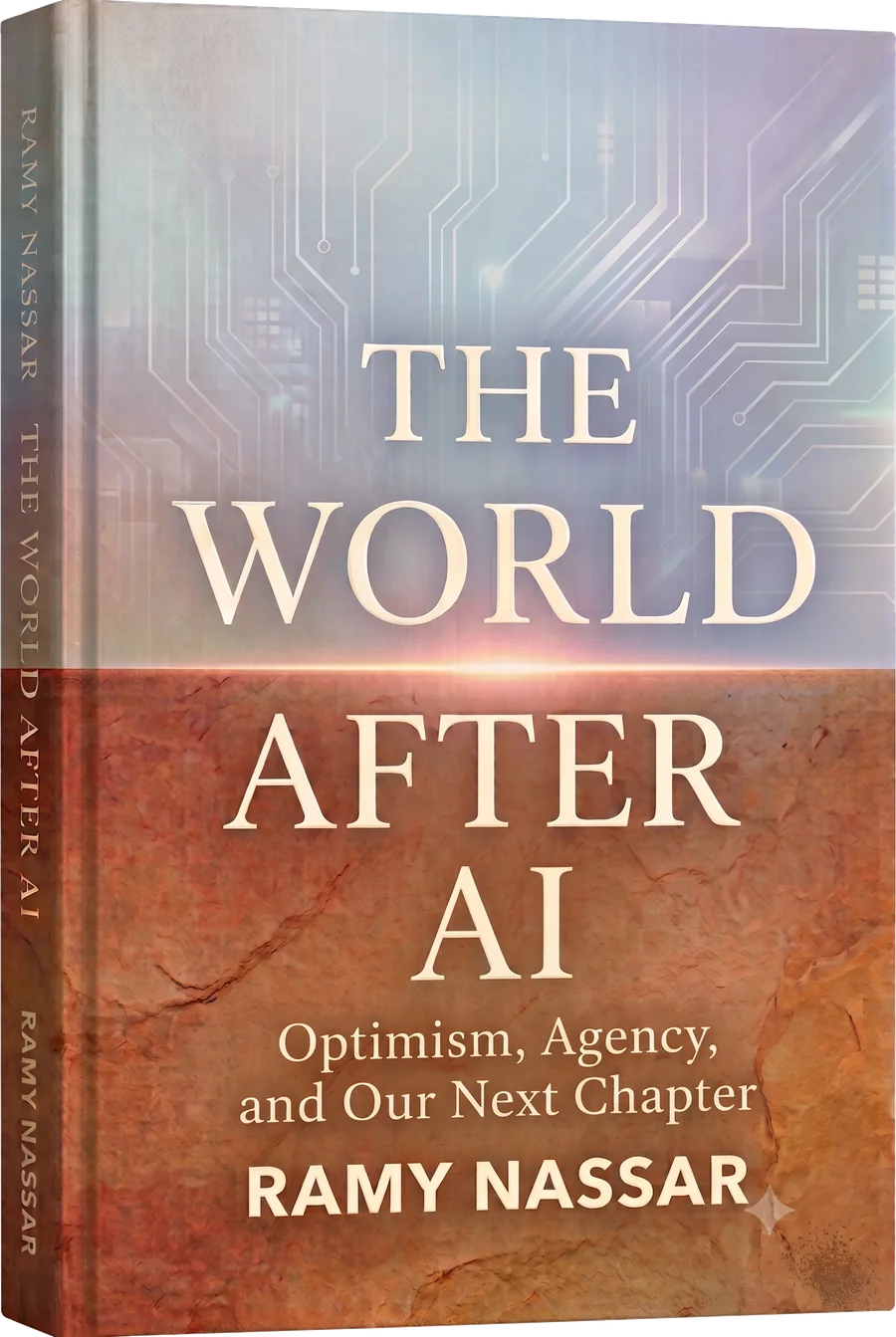
- Title
- The World After AI
- Subtitle
- Why the Future Is Still Ours to Shape
- Author
- Ramy Nassar
- Publisher
- Page Two
- On sale
- April 2027
- Pre-orders
- Opening February 2027
- Formats
- Hardcover, Ebook, Audiobook
- Language
- English
What it is about
The book takes one ordinary Tuesday in 2035 and lives it twice: the same five lives, once in a future we designed on purpose, once in one we let happen by default.
What we get if we make the hard choices now, and decide on purpose how AI fits into the way we live, work, learn, and connect.
What we get if we take the path of least resistance, and let AI quietly reshape all of it by default, with no one ever choosing it.
The technology is not the variable. The choices are.
Who it is for
It is a field guide for workers, parents, and citizens, built on history rather than prediction. Most AI books are written to scare you or sell you. This one does neither. It is written for the person who has to decide: what to do differently at work, at home, and in public life, on an ordinary Tuesday.
The shape of the book
It moves through four worlds, in order. Not a manual, an argument, with a beginning, a turn, and a choice at the end.
- The World We’re EnteringWhat is actually changing now, and why this wave is not like the ones that came before it.
- The World We’re BuildingDomain by domain: how we learn, heal, work, create, trust, connect, and govern.
- The World We’re Leaving BehindThe cost of drift, and the billions the old system already left out.
- The World That’s ComingTwo possible Tuesdays, and what to actually do on the Monday before.
The five people
The book follows five composite, fictional people across five continents through one ordinary Tuesday in 2035.
- Amira, a student, Amman, Jordan
- Maria, a corn farmer, the Sacred Valley, Peru
- Dr. Priya, a rural doctor, Makueni County, Kenya
- David, a former analyst, London, UK
- Jamal, a teenager, Detroit, USA
The ideas
- The Agency WindowThe Agency Window is the stretch of time in which human choices still shape what AI becomes, before the defaults harden and the room to steer quietly narrows.
- The Human RemainderThe Human Remainder is what becomes more essential, not less, once AI takes the task: judgment, taste, presence. A promotion, not a consolation prize.
- The Steam Engine TrapThe Steam Engine Trap is using a new technology to do the old thing slightly better, instead of asking what new thing it now makes possible.
- The Scaling QuestionThe Scaling Question asks whether a technology scales equity or inequality. The same tool can include the billions the old system left out or concentrate power in a few hands, and the answer is never automatic.
- The Tuesday TestThe Tuesday Test is the question every chapter of The World After AI ends on: what should you do differently, as a professional, a parent and a citizen, this Tuesday?
Is AI good or bad?
That is the wrong question, and it is the one question this book will not answer. Nobody asks whether electricity is good or bad. We ask who has it, who does not, what we wire it to, and who decides. The question is who decides.

About the author
Ramy Nassar is a keynote speaker and futurist who has spent twenty-five years inside the rooms where the future gets decided. He was Head of Innovation at Mattel, helped shape the team behind a billion-dollar film, and has guided more than 250 organizations through technological change, among them Apple, Samsung, Disney, TD Bank, Verizon, and the Government of Canada. He holds a B.Sc. Engineering from the University of Guelph, where he studied computer engineering.
He keynotes conferences and leadership gatherings around the world on AI, agency, and designing the future instead of bracing for it, and he teaches at McMaster University, NTNU in Norway, and Saint Mary’s University in Halifax. Futurist.com ranks him #2 on its list of the 30 best AI keynote speakers of 2026, and ProSpeakers lists him first in its Best AI Speakers in Canada for 2026. His through-line is simple: stop reacting to disruption, and start designing it.
Be first to read it
The World After AI lands in April 2027, with pre-orders opening in February 2027. Leave your email and you will hear the moment it does, plus a few thoughtful dispatches along the way. Every signup locks in a permanent Founding Reader number; the earlier you join, the lower yours.
Questions people ask
What is The World After AI about?
The World After AI follows five people through one ordinary Tuesday in 2035, then lives that same day again, differently: same people, same technology, opposite choices. It is not a book about what AI will do to us. It is a book about what we will decide. The technology is not the variable. The choices are.
When does The World After AI come out?
It goes on sale in April 2027 from Page Two, in hardcover, ebook and audiobook.
When can I pre-order it?
Pre-orders open in February 2027. They are not open yet; sign up on this page and you will hear the moment they are.
Who is it for?
Workers, parents, and citizens. It is a field guide for workers, parents, and citizens, built on history rather than prediction. Most AI books are written to scare you or sell you. This one does neither.
Who wrote it?
Ramy Nassar, a futurist and keynote speaker who was Head of Innovation at Mattel and has guided more than 250 organizations through technological change over twenty-five years. He holds a B.Sc. Engineering from the University of Guelph, where he studied computer engineering.
Is it a book about whether AI is good or bad?
That is the wrong question, and it is the one question this book will not answer. Nobody asks whether electricity is good or bad. We ask who has it, who does not, what we wire it to, and who decides. The question is who decides.