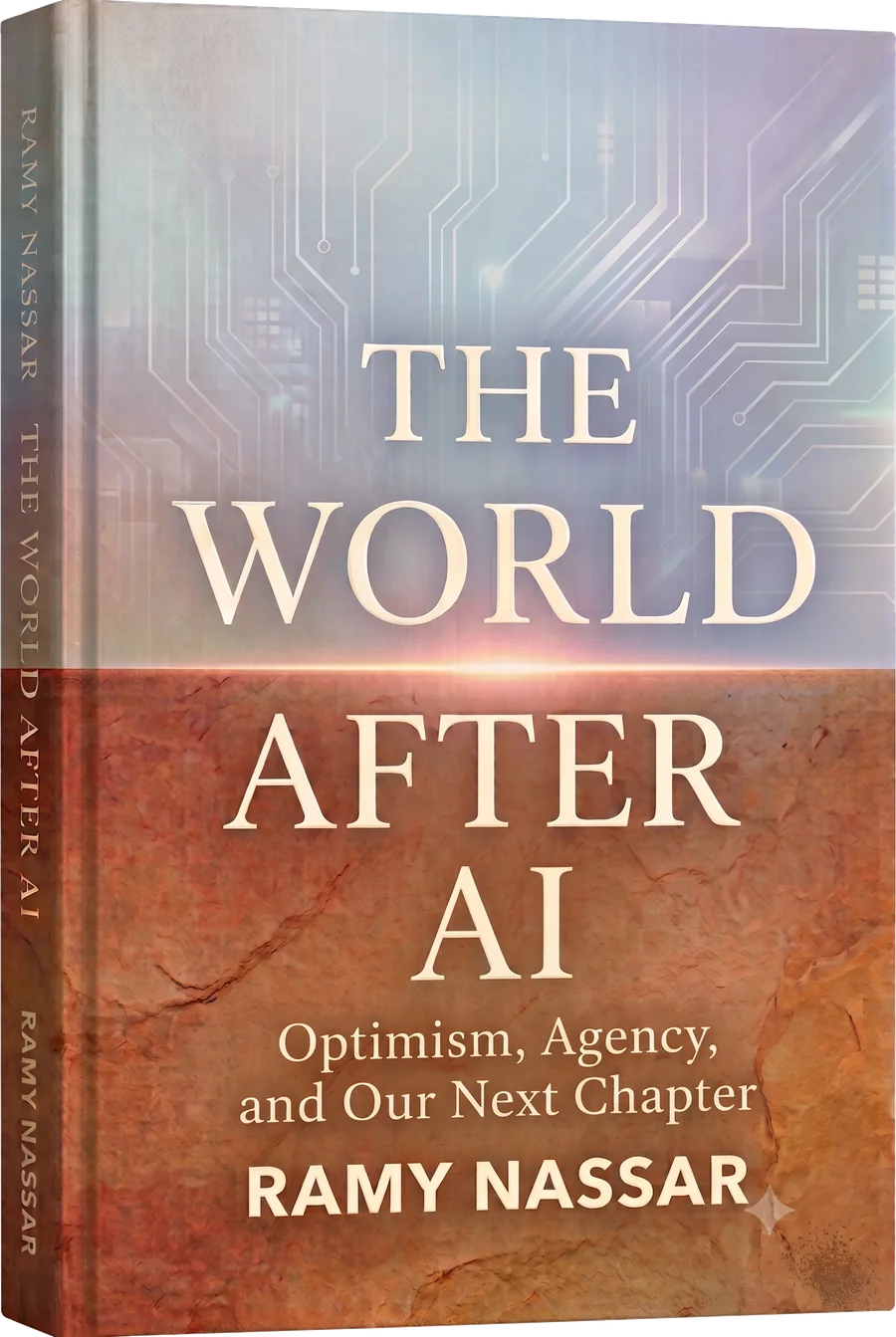
A forthcoming book by Ramy Nassar · Page Two · April 2027
The World After AI
Why the Future Is Still Ours to Shape
A book about the choices that decide what AI becomes, and the part you get to play in them. It opens by refusing the one question everyone else asks.
Is AI good or bad?
That is the wrong question, and it is the one question this book will not answer. Nobody asks whether electricity is good or bad. We ask who has it, who does not, what we wire it to, and who decides. The question is who decides.
The book lands in April 2027, with pre-orders opening in February. Sign up and you will hear the moment it does:
So ask it something real.
Type a real question, the kind you would actually want answered. It will not tell you whether AI is good or bad.
The shape of the book.
It moves through four worlds, in order. Not a manual, an argument, with a beginning, a turn, and a choice at the end.
- 1 The World We’re Entering
What is actually changing now, and why this wave is not like the ones that came before it.
- 2 The World We’re Building
Domain by domain: how we learn, heal, work, create, trust, connect, and govern.
- 3 The World We’re Leaving Behind
The cost of drift, and the billions the old system already left out.
- 4 The World That’s Coming
Two possible Tuesdays, and what to actually do on the Monday before.
Open the book to a random page.
No table of contents, no skipping to the end. Just a real page from somewhere inside, opened at random. Every chapter begins on a true story.
Chapter 1 · The Room That Disappeared
In 1894, a textile factory in the American South did something its owners believed would change everything.
They dismantled the steam engine.
It had powered the building for decades, a massive, smoke-belching machine that drove a system of overhead shafts and leather belts running to every loom and spindle on every floor. The engine was the heart of the factory, and everything was arranged around it. The building itself had been designed to serve it: compact, multi-story, cramped, every machine positioned not where the work needed it but where the belts could reach.
In its place, the owners installed an electric motor.
Edison had lit up Pearl Street in Manhattan twelve years earlier. The technology was proven and the cost was falling. The promise was irresistible: cheaper power, cleaner air, a modern plant for a new century.
The chapter keeps going. Read the rest when it lands →
One Tuesday in 2035, lived twice.
The book takes one ordinary Tuesday in 2035 and lives it twice: the same five lives, once in a future we designed on purpose, once in one we let happen by default.
What we get if we make the hard choices now, and decide on purpose how AI fits into the way we live, work, learn, and connect.
What we get if we take the path of least resistance, and let AI quietly reshape all of it by default, with no one ever choosing it.
Same year, same tools, two completely different days. Neither one is inevitable, and the choices that decide between them are being made right now, mostly by people who do not think of themselves as deciding anything.
Step into the Two Tuesdays →The book, in four numbers.
4.5billion
people the modern economy has always left on the outside
The largest group on earth, and the first technology that could actually include them, or leave them further behind.
300,000years
for all of human history, every tool only extended our bodies
AI is the first one that extends the mind itself, which is why this moment is not like the others.
98percent
of a class is outscored by the one child who gets a personal tutor
One-on-one tutoring is the most powerful tool we have in education. For forty years only the wealthy could afford it. AI could finally put it within reach of every child.
83percent
could not quote a single line of the essay they had just written with AI
Researchers named it cognitive debt: when you let the tool do the thinking, the thinking never becomes yours.
Five people. Five continents. One ordinary Tuesday.
You meet them at dawn and follow the light around the world. They are composites rather than forecasts, written to feel familiar, closer to your own life than any prediction could be.
A 14-year-old. Her AI tutor does the explaining, so her teacher has the time to do the noticing.
A farmer. Her phone can name any crop disease in seconds; her instinct still knows which neighbor to call.
A rural doctor. The AI takes the diagnosis off her plate, which hands her back the patient.
An analyst whose job the machine took. He retrained into the human work a machine cannot do.
A teenager with a flawless AI companion at home, and a friend a real, eleven-minute walk away.
Who is writing this?
Keynote speaker · futurist · former Head of Innovation at Mattel

Ramy Nassar is a keynote speaker and futurist who has spent twenty-five years inside the rooms where the future gets decided. He was Head of Innovation at Mattel, helped shape the team behind a billion-dollar film, and has guided more than 250 organizations through technological change, among them Apple, Samsung, Disney, TD Bank, Verizon, and the Government of Canada.
He keynotes conferences and leadership gatherings around the world on AI, agency, and designing the future instead of bracing for it, and he teaches at McMaster University, NTNU in Norway, and Saint Mary’s University in Halifax. Futurist.com ranks him #2 on its list of the 30 best AI keynote speakers of 2026, and ProSpeakers lists him first in its Best AI Speakers in Canada for 2026. His through-line is simple: stop reacting to disruption, and start designing it.
The World After AI is his case that the future is not something that happens to us. It is something we build, one ordinary Tuesday at a time.
Be there when it opens
Every week, the news swings between AI hype and AI doom. This book does neither. Read it and you will know what to do on Monday morning, not just what to fear in the news. Sign up and you will hear the moment it lands.
Core ideas from the book
The Agency Window
The stretch of time in which our choices still shape what AI becomes. It is open right now, and it will not announce when it closes.
Step inside →For event organizers
Bring this conversation to your stage.
Ramy keynotes on exactly this: AI, agency, and designing the future instead of bracing for it. If you are planning an event, tell him about it.
Or see the full speaker details at ramynassar.com.
Questions people ask
What is The World After AI about?
The World After AI follows five people through one ordinary Tuesday in 2035, then lives that same day again, differently: same people, same technology, opposite choices. It is not a book about what AI will do to us. It is a book about what we will decide. The technology is not the variable. The choices are.
When does The World After AI come out?
April 2027, from Page Two. Pre-orders open in February 2027.
Is AI good or bad?
That is the wrong question, and it is the one question this book will not answer. Nobody asks whether electricity is good or bad. We ask who has it, who does not, what we wire it to, and who decides. The question is who decides.
Will AI take my job?
The wrong unit of analysis. The first wave automates the task. The second eliminates the reason to be in the room. The question that matters is whether your room survives, and what is left that is yours once the machine handles the rest. From the book: Chapter 6, The Last Job Title.
What should my kids study?
Not coding. Not prompting. Building. Seeing a problem that matters, imagining something that does not exist, and bringing it into the world. The language is incidental. The posture is everything. From the book: Chapter 3, The 14-Year-Old’s Tutor.
Who is Ramy Nassar?
Ramy Nassar is a futurist and keynote speaker who has spent twenty-five years inside the rooms where the future gets decided. He was Head of Innovation at Mattel and has guided more than 250 organizations through technological change. He holds a B.Sc. Engineering from the University of Guelph, where he studied computer engineering, and he is the author of The World After AI.